/Technologieën



/
article
/
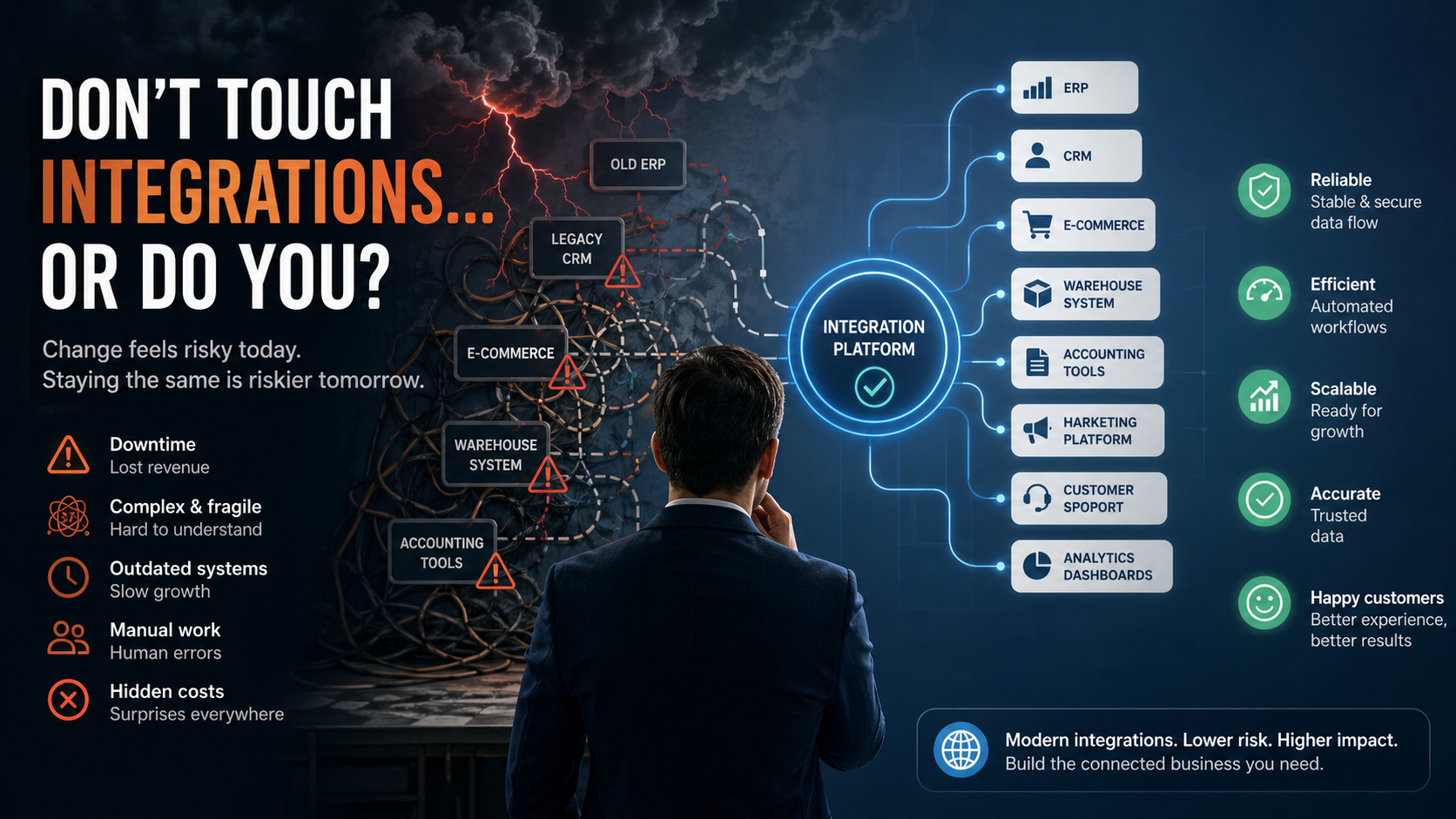
In many companies, there’s an unspoken rule: don’t touch integrations unless absolutely necessary.
And honestly, it’s easy to understand why. Integrations connect the systems businesses rely on every day—ERP, CRM, e-commerce platforms, warehouse software, accounting tools, marketing platforms, and customer support systems. When they work, nobody notices. When they fail, everyone notices immediately.
That’s why any change to integrations is often seen as risky. Sometimes that fear is justified. But the truth is, avoiding change can be even riskier in the long run.
If your business is facing outdated or unstable integrations, learn how modern integration solutions can help on our landing page:
👉 https://www.landpage-preview.com/46fa73b7-db06-4402-bf21-db409d50ff15
Integrations are the digital bridges between systems. They move data, automate workflows, and keep departments aligned.
When one bridge breaks, problems spread quickly.
Common examples include:
At that point, it’s no longer an IT issue—it becomes a business issue.
The biggest concern is simple:
What if something breaks?
Many companies have already experienced how a “small change” caused unexpected problems across multiple systems. A renamed field, changed API response, or new process can trigger a chain reaction.
Management often hears the word “change” and immediately thinks:
So they postpone decisions.
This happens more often than people admit.
Many integrations were built over time:
Documentation is missing or outdated. The original developer has left. The current team only understands pieces of it.
Result?
Nobody wants to touch it.
Many business integrations were never built strategically. They were built quickly to solve immediate problems.
Example:
“We need the e-shop connected to the warehouse by the end of the month.”
So a solution gets built fast—and works under specific conditions. But later, when processes change or data volume grows, cracks start to show.
Updating these systems can be harder than rebuilding them properly.
Some companies still update integrations directly in production. That’s like repairing an engine while driving.
Without a proper testing environment, it’s hard to know:
So teams delay updates because the risk feels too high.
Unlike redesigning a website, integration projects often come with surprises:
That uncertainty makes management cautious.
Let’s be honest.
A new app, AI chatbot, or sleek customer portal sounds more exciting than fixing backend integrations between ERP and CRM.
But without strong integrations, flashy new tools often fail.
Good integrations are invisible—but essential.
Postponing integration updates creates technical debt.
That leads to:
It may seem fine today. But eventually, the cost catches up.
The good news? There’s a better way.
Before changing anything, understand:
Without visibility, change becomes guesswork.
Keep practical records:
This saves time and reduces fear.
Testing with realistic data dramatically lowers risk.
Vermijd „" big bang "” lanceringen.”
In plaats daarvan:
Kleinere veranderingen = kleiner risico.
Volg na de lancering:
Als je problemen niet vroeg ziet, los je ze te laat op.
Integraties zijn geen bijtaken.
Ze vormen het zenuwstelsel van een modern bedrijf.
Bedrijven die investeren in integratiearchitectuur kunnen:
Een bedrijf besluit een nieuw CRM te implementeren.
Alles ziet er geweldig uit, totdat ze beseffen dat het verband moet houden met:
Het project loopt vast, niet vanwege CRM, maar vanwege integraties.
Dit komt zeer vaak voor.
Veel bedrijven zeggen:
„Als het nog steeds werkt, laat het dan met rust.”
Maar oude integraties lijken vaak alleen maar stabiel. In werkelijkheid zijn ze:
Op een dag wordt het probleem urgent en duur.
Bedrijven zijn bang om integraties te veranderen omdat verandering riskant aanvoelt. Downtime, gegevensverlies, onduidelijke architectuur en verborgen kosten zijn echte zorgen.
Maar het uitstellen van de modernisering brengt later vaak grotere risico's met zich mee.
Slimme bedrijven verbeteren integraties met:
Verandering hoeft niet gevaarlijk te zijn.
Als het op de juiste manier wordt behandeld, wordt het een concurrentievoordeel.
Hebt u hulp nodig bij het moderniseren van uw bedrijfsintegraties?
👉 Bezoek onze oplossingspagina: https://www.landpage-preview.com/46fa73b7-db06-4402-bf21-db409d50ff15
Ze verbinden kritieke systemen en automatiseren de gegevensstroom in het hele bedrijf.
Omdat downtime, kapotte workflows en verborgen complexiteit tot grote verstoringen kunnen leiden.
Wanneer ze de groei vertragen, fouten veroorzaken of nieuwe projecten blokkeren.
Met documentatie, testen, monitoring en geleidelijke implementatie.
Verandering = risico: waarom bedrijven bang zijn om integraties aan te raken
/Laten we praten — of je nu al weet wat je nodig hebt of gewoon de mogelijkheden wilt verkennen.

Kantoor NL
Lange Viestraat 2 B, 3511 BK Utrecht
Nederland
Blue Dynamic, B.V.
KVK: 30137532
BTW: NL805557532B01
Kantoor CZ
Prazska 239, 250 66 Praag
Tsjechische Republiek
Blue Dynamic, s.r.o.
NUMMER: 02339234
NUMMER: CZ02339234